
Founder & CEO, Devot AI
A multi-domain Data Scientist and Software Engineer specializing in NLP, Large Language Models, and scalable AI systems. Aviral leads Devot AI with a focus on building production-ready solutions that solve complex business challenges.
Generative coding is advancing quickly, and Cursor Composer 2 represents Cursor's latest milestone in that evolution. Rather than focusing only on faster code generation, the release emphasizes stronger coding performance, improved long-horizon task completion, and a balance between capability and cost that aims to make advanced AI coding more accessible.
Executive Summary
Cursor Composer 2 introduces a significant update to Cursor's AI coding capabilities, combining stronger coding intelligence with a more cost-efficient pricing model. The release is backed by measurable improvements across CursorBench, Terminal-Bench 2.0, and SWE-bench Multilingual, along with a new training approach that strengthens the model through continued pretraining and reinforcement learning.
This guide explores what Composer 2 brings to developers, how its training methodology contributes to improved coding performance, and why its benchmark results represent an important step in the evolution of AI-assisted software development.
Understand what makes Cursor Composer 2 different from previous Composer releases.
Explore the benchmark improvements across CursorBench, Terminal-Bench 2.0, and SWE-bench Multilingual.
Learn how continued pretraining and reinforcement learning contribute to long-horizon coding capabilities.
Discover the pricing options and availability of Composer 2 and its faster variant.
Introduction
Artificial intelligence continues to reshape how developers approach software development, and coding assistants are evolving beyond simple code completion. Cursor Composer 2 represents the latest step in that evolution, introducing stronger coding capabilities through continued pretraining and reinforcement learning while delivering notable improvements across industry coding benchmarks.
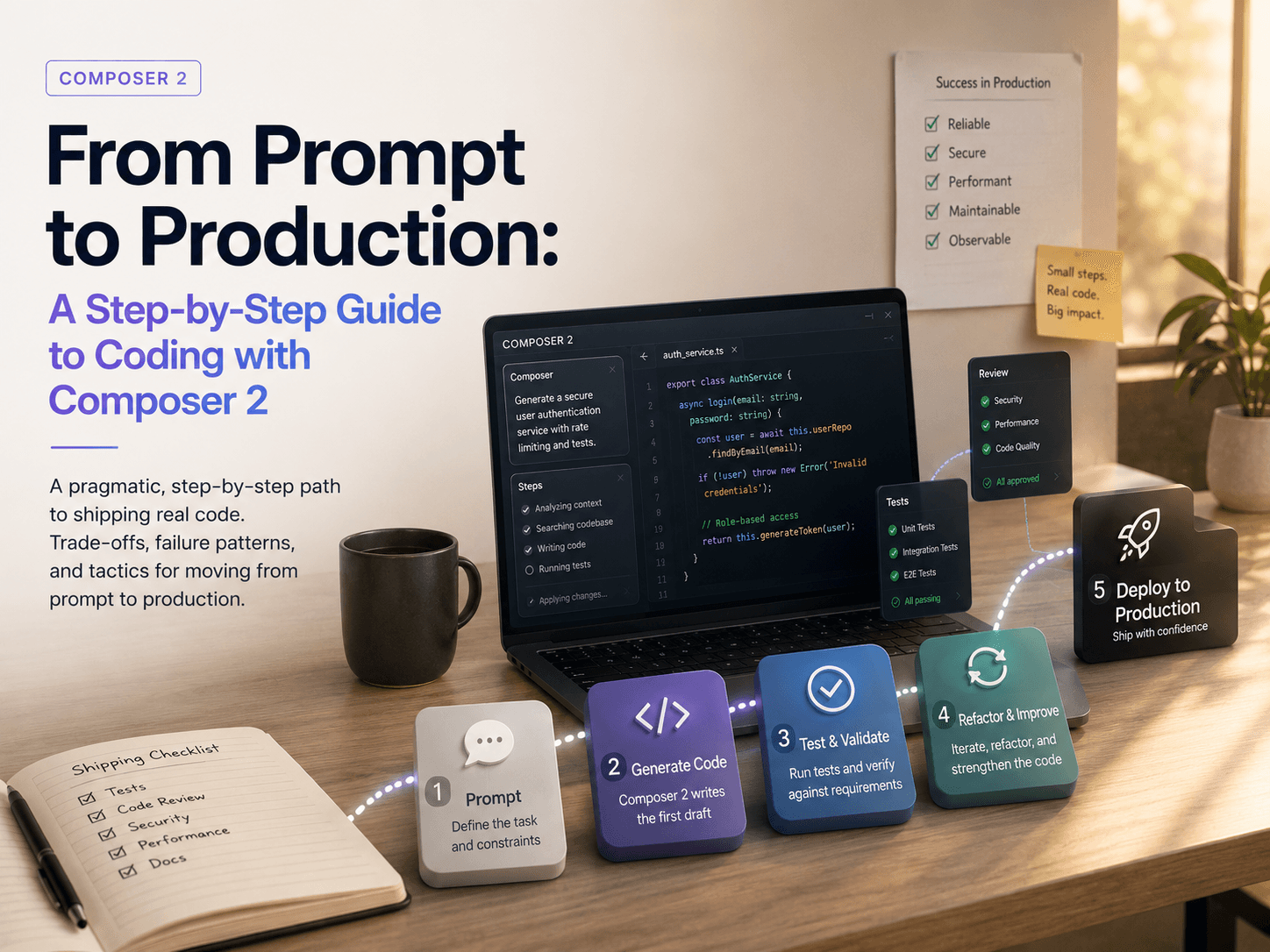
This is what From Prompt to Production: A Step-by-Step Guide to Coding with Composer 2 explores. Rather than looking only at the announcement itself, this guide examines the key advancements behind Composer 2, including its training approach, benchmark performance, pricing, and the capabilities that distinguish it from previous Composer releases.
The growing interest in AI-assisted coding reflects a broader shift toward more capable development tools that can handle increasingly complex programming tasks. With improvements in CursorBench, Terminal-Bench 2.0, and SWE-bench Multilingual, Composer 2 demonstrates Cursor's continued focus on advancing coding intelligence while making high-performance AI models more accessible.
Composer 2's advancements: what the latest release introduces
Composer 2 represents Cursor's latest advancement in AI-assisted coding, combining a stronger training foundation with measurable improvements across multiple coding benchmarks. According to Cursor, the model benefits from its first continued pretraining run, which provides a more capable base for reinforcement learning on complex coding tasks.
One of the most notable aspects of the release is its focus on long-horizon coding. Cursor states that Composer 2 can solve coding tasks requiring hundreds of actions, moving beyond isolated code generation toward handling more complex development workflows. This capability is supported by improvements across CursorBench, Terminal-Bench 2.0, and SWE-bench Multilingual when compared with previous Composer releases.
How Composer 2 builds on earlier versions:
The benchmark results highlight a clear progression from Composer 1 and Composer 1.5. CursorBench increased from 38.0 in Composer 1 to 61.3 in Composer 2, while Terminal-Bench 2.0 improved from 40.0 to 61.7. Composer 2 also achieved 73.7 on SWE-bench Multilingual, demonstrating stronger performance across the evaluation metrics shared in the announcement.
What contributes to these improvements
Cursor attributes these gains to two primary developments. The first is continued pretraining, which creates a stronger foundational model. The second is reinforcement learning focused on long-horizon coding tasks, enabling the model to address programming challenges that require extended reasoning and multiple coordinated actions rather than isolated code completions.
Why these benchmark results matter
Benchmark scores provide a consistent way to evaluate progress across successive model releases. While they do not represent every real-world development scenario, they offer measurable evidence of improvements in coding capability under standardized evaluation frameworks. In the case of Composer 2, the published results indicate substantial progress over previous Composer models across all three reported benchmarks
Understanding the advancements behind Composer 2
Composer 2 is built on Cursor's first continued pretraining run, creating a stronger foundation for reinforcement learning on coding tasks. According to Cursor, this approach enables the model to handle long-horizon coding challenges that require hundreds of coordinated actions instead of isolated code completions.
The release focuses on improving both capability and accessibility. Rather than introducing a single feature, Composer 2 combines higher benchmark performance with a pricing model designed to make frontier-level coding intelligence available at a lower cost than previous offerings.
Where the improvements become visible:
Stronger coding performance
Composer 2 achieves measurable improvements across CursorBench, Terminal-Bench 2.0, and SWE-bench Multilingual when compared with Composer 1 and Composer 1.5. These benchmarks provide standardized evaluations of coding capability and demonstrate the model's progress across different programming challenges.
Long-horizon coding capability
Cursor states that Composer 2 is trained to solve coding tasks requiring hundreds of actions. This reflects a shift from handling isolated code snippets toward managing more extended programming workflows during benchmark evaluations.
Improved training methodology
The announcement attributes these performance gains to continued pretraining followed by reinforcement learning. By strengthening the underlying model before reinforcement learning begins, Cursor aims to improve the model's overall coding intelligence.
Balanced intelligence and cost
Alongside performance improvements, Cursor introduces a pricing model that combines frontier-level coding capability with lower input and output token costs. A faster variant is also available, offering the same intelligence while prioritizing response speed.
What Composer 2 brings to developers
Improved coding performance
Composer 2 demonstrates measurable gains across CursorBench, Terminal-Bench 2.0, and SWE-bench Multilingual when compared with previous Composer models. These results indicate that the model is better equipped to tackle a broader range of coding challenges under standardized benchmark conditions.
Refactor request during a hotfix
Composer 2 suggests consolidating similar functions while fixing a bug. You ask it to isolate the bug fix forward only. The refactor happens next sprint. You avoid widening blast radius during an incident window.
Better support for complex coding tasks
One of the key highlights of Composer 2 is its ability to solve long-horizon coding tasks requiring hundreds of actions. This represents a notable advancement over previous Composer releases and reflects Cursor's continued investment in improving AI-assisted software development.
A stronger training foundation
Cursor attributes Composer 2's performance improvements to its first continued pretraining run, which creates a stronger base for reinforcement learning. This combination enables the model to build upon previous capabilities while improving performance across multiple coding evaluations.
How Composer 2 reflects Cursor's latest progress
Composer 2 represents the next stage in the evolution of Cursor's AI coding models. Compared with Composer 1 and Composer 1.5, it delivers stronger performance across CursorBench, Terminal-Bench 2.0, and SWE-bench Multilingual while introducing a new training approach based on continued pretraining and reinforcement learning. Rather than focusing on a single improvement, the release combines higher coding capability, support for long-horizon coding tasks, and a more competitive pricing model.
The announcement also introduces a faster Composer 2 variant that delivers the same coding intelligence while prioritizing response speed. Together, these updates demonstrate Cursor's continued focus on improving both model capability and accessibility for developers.
FAQ
What is Cursor Composer 2?
Cursor Composer 2 is Cursor's latest AI coding model, designed to deliver stronger coding performance through continued pretraining and reinforcement learning.
What improvements does Composer 2 introduce?
According to Cursor, Composer 2 achieves higher scores across CursorBench, Terminal-Bench 2.0, and SWE-bench Multilingual compared with previous Composer releases.
What are long-horizon coding tasks?
Cursor describes these as coding tasks that require hundreds of coordinated actions rather than isolated code completions, allowing the model to tackle more complex programming challenges.
Is Composer 2 available in different versions?
Yes. Cursor offers Composer 2 alongside a faster variant that provides the same coding intelligence while prioritizing response speed.
Why did Cursor change the training approach?
The announcement explains that continued pretraining creates a stronger foundation for reinforcement learning, contributing to improved coding performance across the published benchmarks.
The next step in AI-assisted coding
Composer 2 reflects Cursor's continued investment in advancing AI coding models through stronger training methods and measurable improvements across established coding benchmarks. By combining continued pretraining with reinforcement learning, the release demonstrates how AI coding assistants are evolving to handle increasingly complex programming tasks.
As coding models continue to improve, benchmark performance, training methodology, and practical accessibility will remain important factors when evaluating new AI development tools. Composer 2 represents another step in that progression, building on previous Composer releases while introducing stronger coding capabilities at a more accessible cost.